RACIAL COVENANTS
Many residential neighborhoods in the United States built in the early Twentieth century were constructed on large tracts of land (often farms) which real estate developers purchased and partitioned into lots to form a subdivision. Legal documents known as deeds were used to transfer ownership of these individual lots from the developer to either homebuilders or homebuyers, and agreements known as restrictive covenants (legally enforceable provisions which have long been recognized as a fundamental part of American property law) were often included in the deeds to place certain limits on how the land could be used ① . These rules of the community often seek to maintain the attractiveness and value of that property and enforce a standard of uniformity across the development. Common examples of restrictive covenants forbid the raising livestock or the manufacturing or sale of alcohol, or the required distance from the home to the street.
Perhaps the earliest example of a racial restrictive covenant appears in a deed from November 20, 1854, transferring a tract of land in the District of Columbia to Charles Henry Nichols in an area called Uniontown (Washington D.C.'s first planned suburb, now the Anacostia neighborhood) that was intended "for the use benefit and enjoyment of white persons only," and that further read in part:
"said lots or parcels of ground shall not be sold, leased, or devised to any negro, mulatt[o] or person of African bloo[d]: nor shall the same be held, possessed or enjoyed by such person through the intervention of Trustees....②"
Another early example of a racial covenant, found in an 1855 Brookline, MA, deed from Amos A. Lawrence to Ivory Bean, read:
“is subject to the following restrictions and conditions, viz: that the said Bean his heirs and assigns shall never erect or place upon said land any building or part thereof which shall be used for the trade or calling of a butcher currier, tanner, varnish maker, inkmaker, tallow chandler, soap boiler brewer, distiller, sugar baker, dyer, tinman, working brazier, founder, smith, or brick maker nor for occupation by any negro or negroes nor by any native or natives of Ireland nor for any noisy nauseous or offensive business trade whatsoever nor occupy said lot for these or any other purposes which shall tend to disturb the quiet or comfort of the neighborhood.... ③”
Other early examples from the 1890s were reported to prevent Chinese occupancy or homeownership in California ④. One such covenant was at the center of Ganfolfo v. Hartman, a case tried in1892 before the U.S. District Court in the Southern District of California. A deed for property on East Main street in the town of San Buena Ventura, Ventura County, California, had been transferred on March 22, 1886, that contained the following covenant:
"It is also understood and agreed by and between the parties hereto, their heirs and assigns, that the party of the first part shall never, without the consent of the party of the second part, his heirs or assigns, rent any of the buildings or ground owned by said party of the first part and fronting on said East Main street, to a Chinaman or Chinamen. This agreement shall only apply to that part of lot 2, block 47, aforesaid, lying north of the alley-way hereinbefore described, and fronting on said East Main street. And said party of the second part agrees for himself and heirs that he will never rent any of the property hereby conveyed to a Chinaman or Chinamen ⑤."
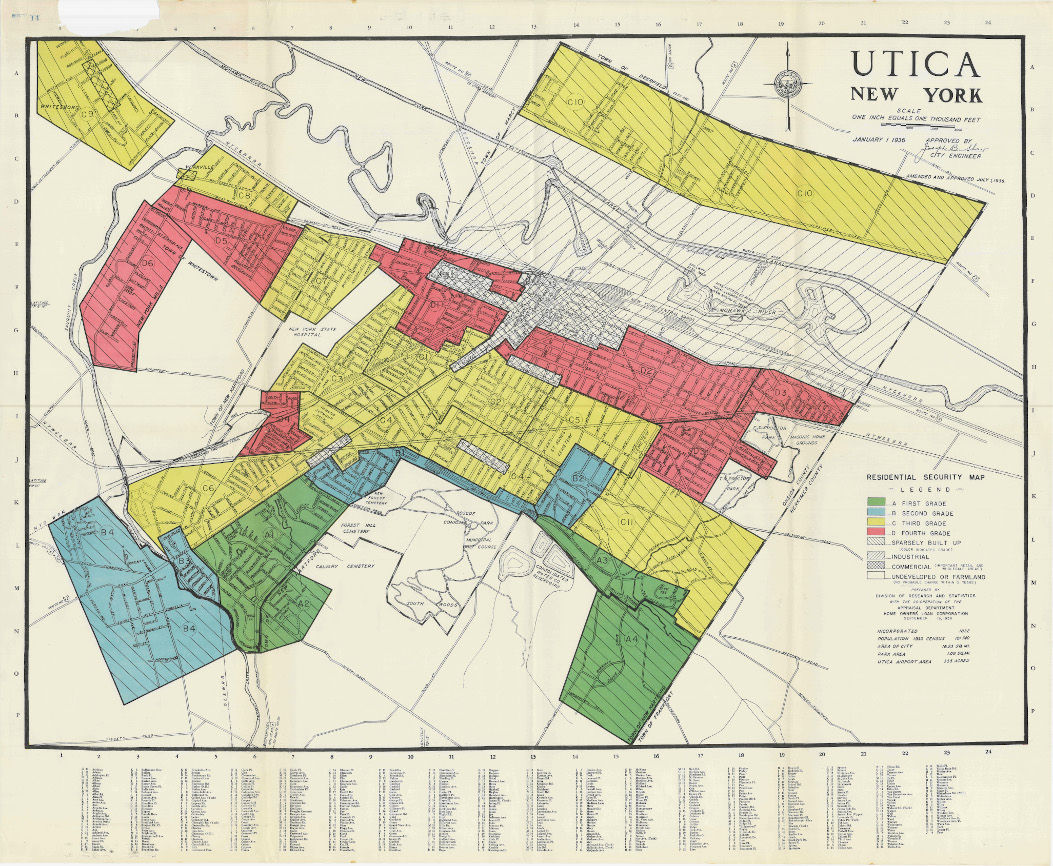
Starting in the early 1900s, racial restrictive covenants (or simply racial covenants) were propagated across the country by homebuilders and the real estate industry (and later, at much greater scale, by federal agencies such as the Home Owners Loan Corporation and the Federal Housing Administration) and typically forbade property owners from allowing non-White people to buy, live on, or use their property ⑥.
For three decades, courts enforced racial covenants such that “if a Black renter or homebuyer attempted to move into a house with a restrictive covenant, any White resident in that suburban development could sue to remove them from the neighborhood ⑦.”
Although the majority of racial covenants appear to specify that only members of the white or Caucasian race may own, occupy, or otherwise use property in residential areas designated as white communities, others enumerate the various prohibited racial, ethnic, and religious groups. One example in Verona, NY, reads as follows: "The grantee herein his heirs and assigns, shall never sell or lease, in whole or any part of said premises, to any person or persons of the Polish, Greek, Jewish, Negro or Yellow races nor to any association, co-partnership, or corporation composed in whole or in part of those races or either of them ⑧.” The use of racial covenants quickly became so popular that in “1937 a leading magazine of nationwide circulation awarded ten communities a ‘shield of honor’ for an umbrella of restrictions against the ‘wrong kind of people ⑨.’”
In Shelley v. Kraemer, the U.S. Supreme Court held in 1948 that although racially restrictive covenants are not per se illegal, the Fourteenth Amendment did prevent courts from enforcing them because to do so would constitute state action. Despite this decision, racial covenants persisted as they were viewed as voluntary agreements between private buyers and sellers, giving neighbors legal leverage over one another’s sales and rentals by threatening to sue for damages rather than seeking an injunction against the sale ⑩.
Racial covenants were made illegal in New York with the passage of The Metcalf-Baker Fair Housing Law in 1961, and the use of racial covenants was finally made illegal nationwide through The Fair Housing Act of 1968, under which it became unlawful to refuse to sell, rent to, or negotiate with any person because of that person's race, color, religion, sex, familial status, handicap, or national origin. And yet they still crop up in the chain of title.
Covenants, including racial covenants, “run with the land,” and this “‘sticky’ quality is an artifact of the Anglo-American conveyancing system, which looks to the history of past transactions to ascertain the claims against any given title ⑪.”
① Bond, C.B. (2004). Does Increasing Black Homeownership Decrease Residential Segregation? Unpublished dissertation, University of Notre Dame.
② Deed, 20 November 1854, Liber JAS 90, pp 77-79, DC Archives, courtesy of Mara Cherkasky
③ Liss, K., (2022). “Thomas Aspinwall Davis, Amos Lawrence, and Brookline Racial Covenants." Accessed at https://brooklinehistoricalsociety.org/RaceAndClass/RacialCovenants.pdf
④ Abrams, C. (1947, May). "Homes for Aryans Only: The Restrictive Covenant Spreads Legal Racism in America." Accessed at https://www.commentary.org/articles/charles-abrams/homes-for-aryans-onlythe-restrictive-covenant-spreads-legal-racism-in-america/
⑤ Gandolfo v. Hartman, 49 F. 181 (S.D. Cal. 1892). Accessed via https://case-law.vlex.com/vid/gandolfo-v-hartman-892367409
⑥ “The 5 Key Elements Of Your Legally Binding CC&Rs.” Accessed at https://www.hopb.co/blog/5-key-elements-of-legally-binding-hoa-ccrs
⑦ “Confronting racial covenants: How they segregated Monroe County and what to do about them.” Accessed at https://law.yale.edu/sites/default/files/area/clinic/document/2020.7.31_-_confronting_racial_covenants_-_yale.city_roots_guide.pdf
⑧ Deed, 11 September 1929, (Deed Book 906, page 89-90, Records Department of the Office of the Oneida County Clerk, Oneida County, NY).
⑨ “Understanding Fair Housing,” U.S. Commission on Civil Rights Clearinghouse Publication 42, February 1973. Accessed at https://files.eric.ed.gov/fulltext/ED075565.pdf
⑩ https://supreme.justia.com/cases/federal/us/334/1/
⑪ “Racial Covenants and Segregation, Yesterday and Today,” Brooks and Rose (2010). Accessed at
http://www.law.nyu.edu/sites/default/files/siwp/Rose.pdf
© JULY 2026

Example of a racial covenant, found by the homeowner in the title abstract for 106 Clarmar Rd., Fayetteville, NY.
